
US Tariffs and Global Default Risk: 9 Months On
Posted by Laura Saville on February 5, 2026

US Tariffs announced on 2nd April 2025 were, briefly, a major shock to equity markets; but after multiple amendments, investors are less sensitive to new announcements. However, Credit Benchmark consensus default risk estimates show material shifts in underlying credit quality, which are at least partly due to the negative and positive impacts of tariff changes.
GDP, Credit and Equity Markets
The two charts below show GDP growth rate changes since April 2025 (first chart), and default risk changes vs. relative equity market performance (second chart).
Changes in GDP Growth Rate Apr-Dec* 2025

Default Risk vs. Equity Performance

Global Industry Changes
The table below shows changes in default risk and average net downgrades by global sector (ex US) in 2025, based on Credit Benchmark’s consensus data:
Average Default Risk Changes, Global Industries ex US

Average Credit Risk Index (CRI – Net Downgrade %), Global Industries ex US
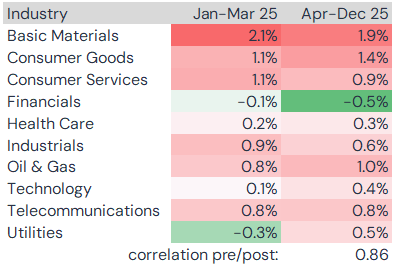
Since tariffs were announced, Basic Materials have deteriorated by more than 7%, followed by Consumer Goods, Telecommunications, and Oil & Gas in the 3% to 4.3% range. Consumer Services, Technology, Industrials, Health Care run from 1.5% to 2.7%. Financials and Utilities are the only sectors to see an improvement.
Industry rankings are similar in the first three months of 2025, and the pre/post correlation is almost 0.7 – implying that the impact of tariffs was anticipated by major banks. Net Downgrades show a very similar pattern although Utilities show some deterioration since April 2025.
Corporate Changes by Country
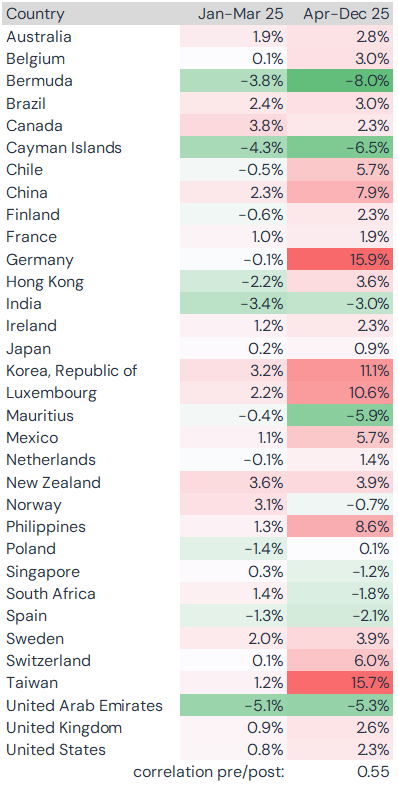
For Corporates by country, the same metrics and time periods show some dramatic differences:
Average Default Risk Changes, Corporates
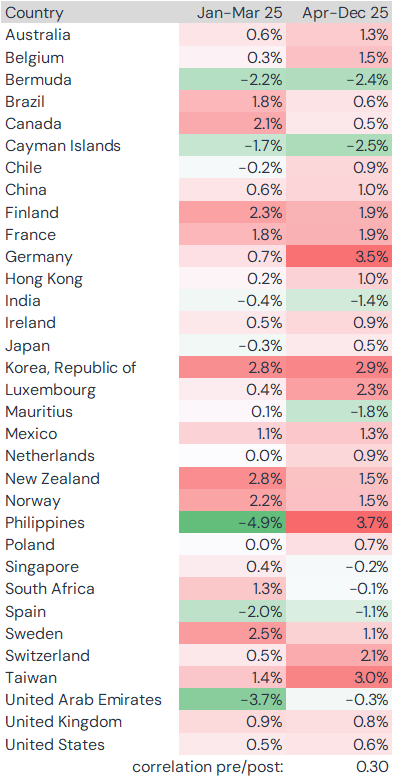
Average Credit Risk Index (CRI – Net Downgrade %), Corporates
Most offshore centres have done very well, but Luxembourg has deteriorated by more than 10% in the post-tariff period. Germany, Taiwan and Korea have also been badly affected, with double-digit increases in default risk – and in some cases these were not anticipated in the first few months of the year. Apart from offshore domiciles, the only countries to show default risk improvements are India, Norway, Singapore, South Africa and Spain. All other countries, including the US, show some deterioration. Poland, Japan, Netherlands and France have only been marginally affected so far.
The CRI (net downgrade) table shows a similar overall pattern, but more countries record average net downgrades in the post-tariff period. The CRI captures broad-based deterioration, so there is a risk of further rises in default risk over coming months even in countries that have so far seen stable or improving PDs.
Country / Sector Highlights
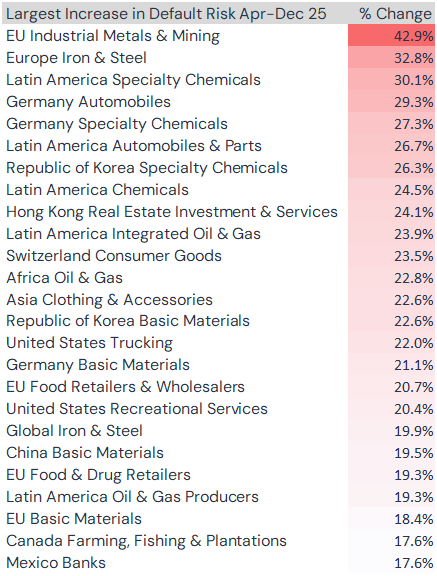
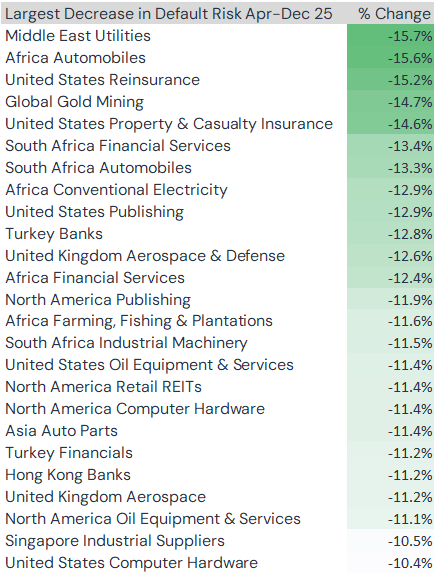
The next table shows the Country/Sector detail (including Financials) highlighting the top 25 largest increases and decreases in default risk:
Largest Increase in Default Risk Apr-Dec 25
Largest Decrease in Default Risk Apr-Dec 25
The largest risk increases are concentrated in Basic Materials, including Chemicals, Non-Precious Metals, Autos, Retailers, and some Oil & Gas producers. The geographic spread is wide, although the US impact is limited to Trucking and Recreational Services. Asia is also patchy, with Basic Materials as the only sector where China features directly.
Credit risk improvements are widespread in Africa and the Middle East, which reflects some shifts in the balance of global financial power as well as the importance of African commodities to the global Technology sector. Autos also appear (in Asia and Africa) and UK Aerospace / Defence reflects rising geopolitical tensions. Financials, especially Insurance, are a major beneficiary since April 2025 in multiple countries. Gold Mining is also an unsurprising strong performer.
PD and CRI Changes Since April 2025 by Country
Credit Benchmark launched the US Private Obligor Credit Risk Index (“CRI”) in Q4 2025, to track the monthly pattern of net credit downgrades across Corporates and Financials for medium and large borrowers without an equity market listing. The same metric can be used for any universe of obligors.
This report covers a turbulent period for underlying credit risk in the global economy. While changes in the average consensus PD are used here to show the direct impact on credit, the CRI can be used to assess the breadth of that impact. Since it counts all downgrades net of upgrades (however small) it can show when credit is broadly deteriorating in multiple countries or sectors which may have a strong bearing on portfolio management decisions.
The chart below plots the relationship between cumulative CRI since April 2025 and PD change for Corporate credit universes in the countries listed in this report:
Cumulative CRI vs PD Changes in Corporates by Country, Apr-Dec 2025
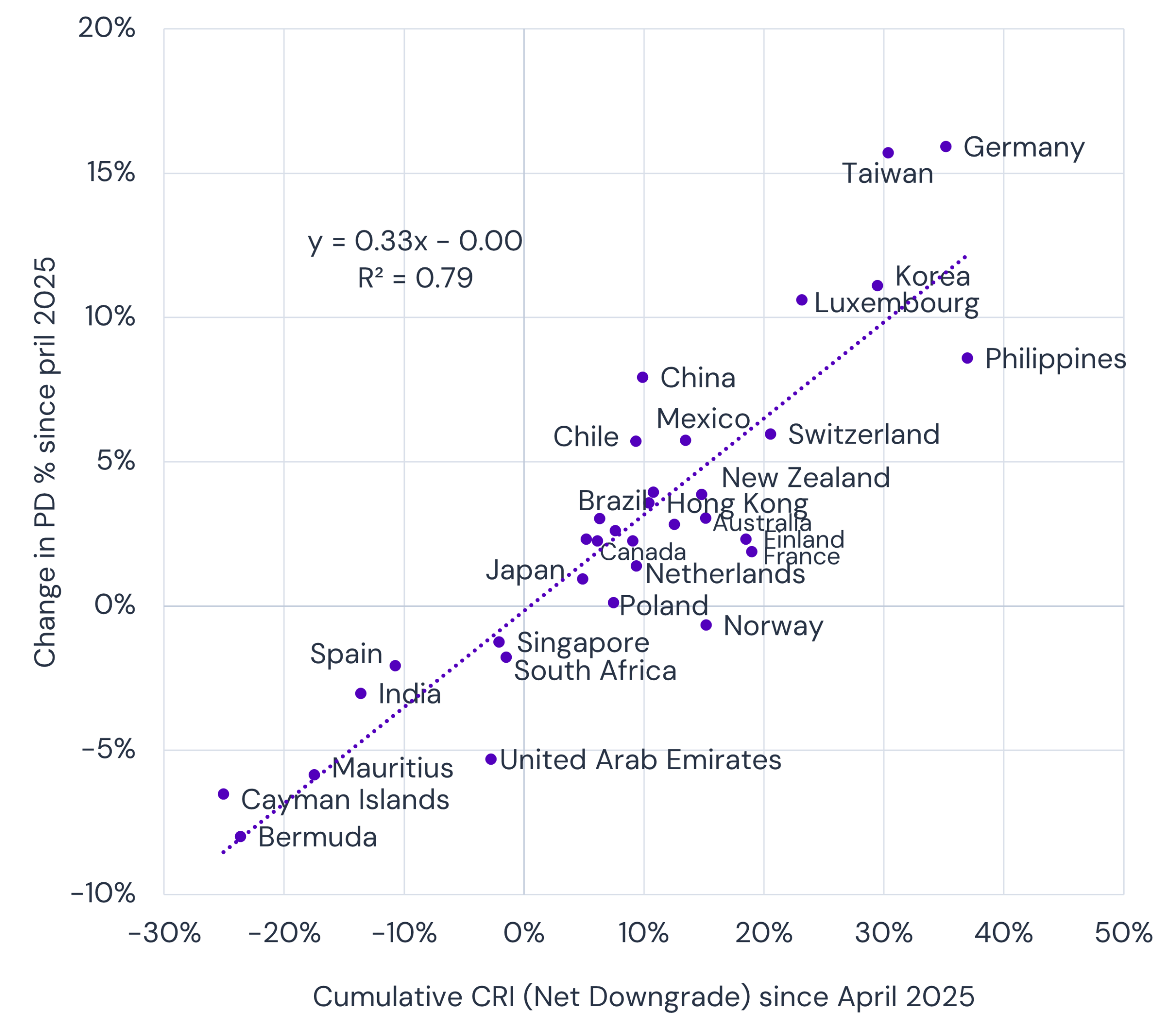
The fitted line shows a strong positive relationship with a slope of 0.33 – in other words, over this period, a 10% increase in CRI is associated with a 3.3% increase in PD. There is some evidence in preliminary Credit Benchmark research that the CRI might have some predictive value in anticipating future PD changes, although the strength of any effect and the prediction lag may be variable.
Countries that do not lie close to the fitted line (e.g. Germany, Norway, Taiwan, UAE) may experience broad-based downgrades – a small change in CRI and a large change in PD probably implies that the PD change is concentrated in a few obligors or a single sector.
Conclusions
Global corporate credit deteriorated moderately in 2025, although some geographies bucked the trend. The main losers were Basic Materials including Chemicals and Non-Precious Metals, as well as Autos and Retail in many regions. Financials broadly improved along with Precious Metals.
Tariffs have clearly had an impact, but some of the moves noted here are due to general credit shifts, interest rate cycles and geopolitics. Medium sized Asian countries shrugged off tariffs, probably because of Chinese production relocating. Europe has struggled but that is partly due to the need to increase defence spending, and generally sluggish growth in Germany.
So far, tariffs have not brought the US any obvious net credit benefit – it has deteriorated in line with Canada, although outperforming China and Europe.
Global supply chains are shifting, benefitting medium sized Asian countries; while the scramble for raw materials has been a major positive for Africa and the Middle East.
Tariffs clearly have an impact, exposing concentration risk and other pockets of risk. But the global economy has been swift to adapt so the impact may not be what was intended. If current trends continue and global manufacturing demand softens, Germany, Taiwan and Korea may see additional deterioration. Conversely, Financials-heavy countries would remain net beneficiaries, as would countries benefitting from relocation of manufacturing.
Clients can use Credit Benchmark’s Consensus Credit Ratings and sector- and country-level analytics to track how tariff impacts, supply-chain shifts, and macro pressures are translating into real changes in default risk across global portfolios.
Get in touch to learn more.
Download PDF
Please complete your details to download the PDF of this report.
"*" indicates required fields
By submitting this form you agree to Credit Benchmark’s Privacy Policy and Terms and Conditions.




Want to see Credit Benchmark in action?
Schedule a short 30 minute demo and let our team walk you through the platform, demonstrate key capabilities, and answer any questions live.