
Italian Credit Resilience Tested by Geopolitical and Regional Stress
Posted by Laura Saville on July 25, 2026

Executive Summary
Italian credit fundamentals remain resilient despite rising geopolitical and macroeconomic pressures, with Investment Grade strength offsetting pockets of stress in High Yield and southern regions. Italian corporates have outperformed global peers in recent years, although most credit indices weakened modestly in the past month as the Middle East conflict intensified energy and market risks.
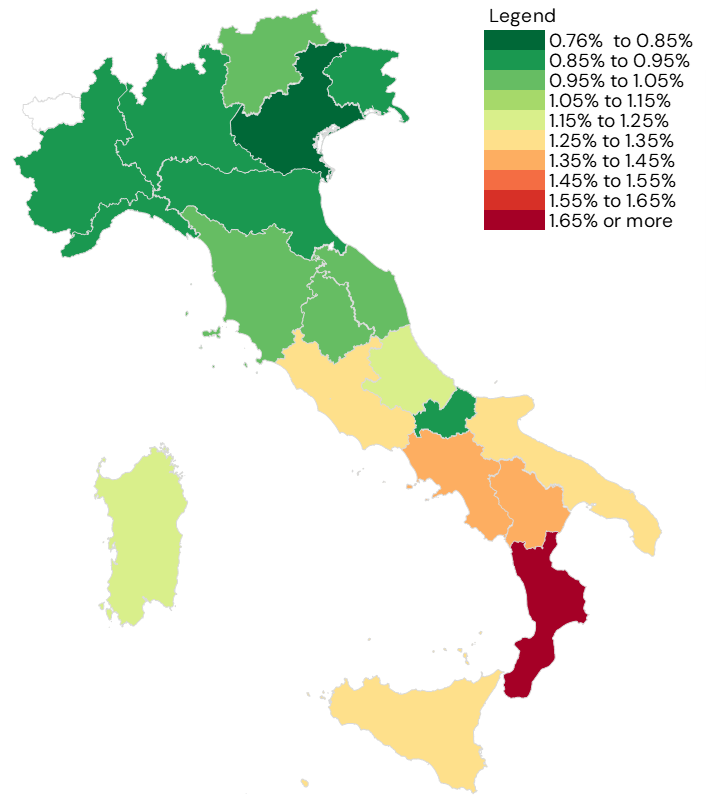
Italian Corporates and Financials continue to exhibit unusually similar credit profiles, both concentrated in the ‘bb’ category. Regional divergence remains pronounced, with the highest default risk in Calabria and Campania, while Veneto and Piemonte remain the strongest-performing regions.
Tail-risk indicators are elevated in Calabria, Sardegna and Lazio, highlighting concentrated vulnerabilities. Financials have experienced broader downgrade pressure than Corporates in recent months, led by deterioration in Marche. Recent downgrades have been concentrated primarily among High Yield industrial borrowers, while upgrade momentum remains strongest in selected Investment Grade sectors.
Overview
Italy’s economy is expected to grow modestly in 2026, supported by domestic demand and continued RRF investment, although growth is likely to remain below the Eurozone average.
High public debt remains a structural constraint, but stable sovereign ratings in the BBB category reflect improving fiscal discipline and contained inflation. At the same time, the escalating Middle East conflict, alongside tariffs and broader geopolitical fragmentation, continues to weigh on Italy’s external outlook through higher energy and trade-related risks.
Corporate default risk is expected to rise moderately during 2026 but remain within manageable levels overall. Credit conditions continue to favour Investment Grade issuers, while stress remains concentrated in weaker High Yield industrial, real estate and retail segments.
Italian banks remain resilient, supported by solid capital buffers and improved balance sheet quality, despite a recent increase in downgrade activity across parts of the Financials sector.
Italian Corporate Credit Outperforms Global Peers
Rebased Change in Credit Risk: Italy Corporates, Investment Grade vs. High Yield vs. Global Corporates
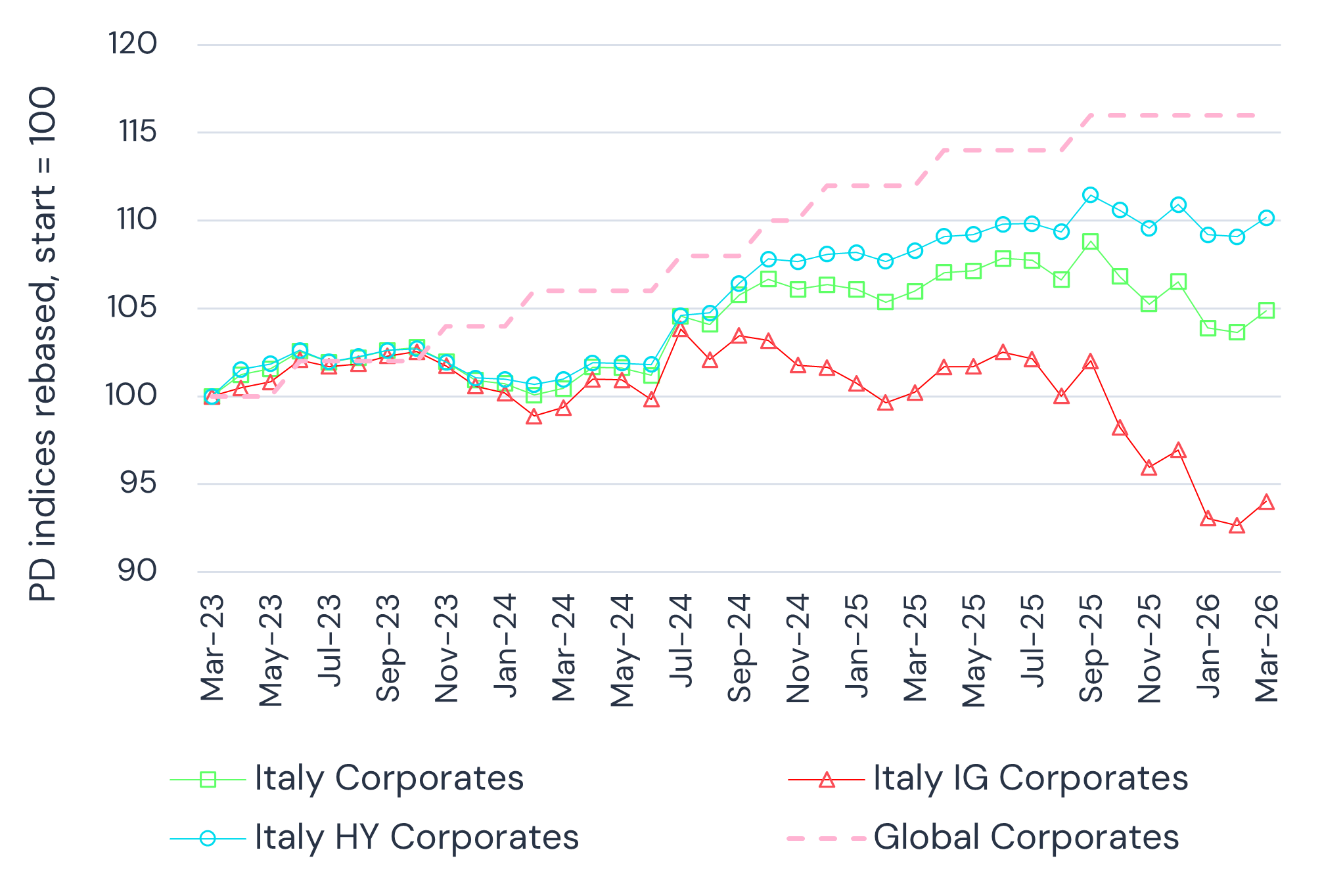
Italian corporates have outperformed the global corporate credit index over the past three years, supported by improving domestic balance sheets, fiscal policy support and the steady deployment of RRF funding.
- Italian corporates have outperformed the Global index in recent years across both rating buckets.
- Italian Investment Grade Corporates have steadily improved over the past nine months.
- Italian High Yield Corporates have stabilised in the past six months after modest prior deterioration.
- Investment Grade improvement has been the key driver of Italy’s outperformance versus global peers.
Credit Profile Distribution: Why Italian Corporates and Financials Look Alike
Credit Profile: Italy Financials, Corporates, Funds
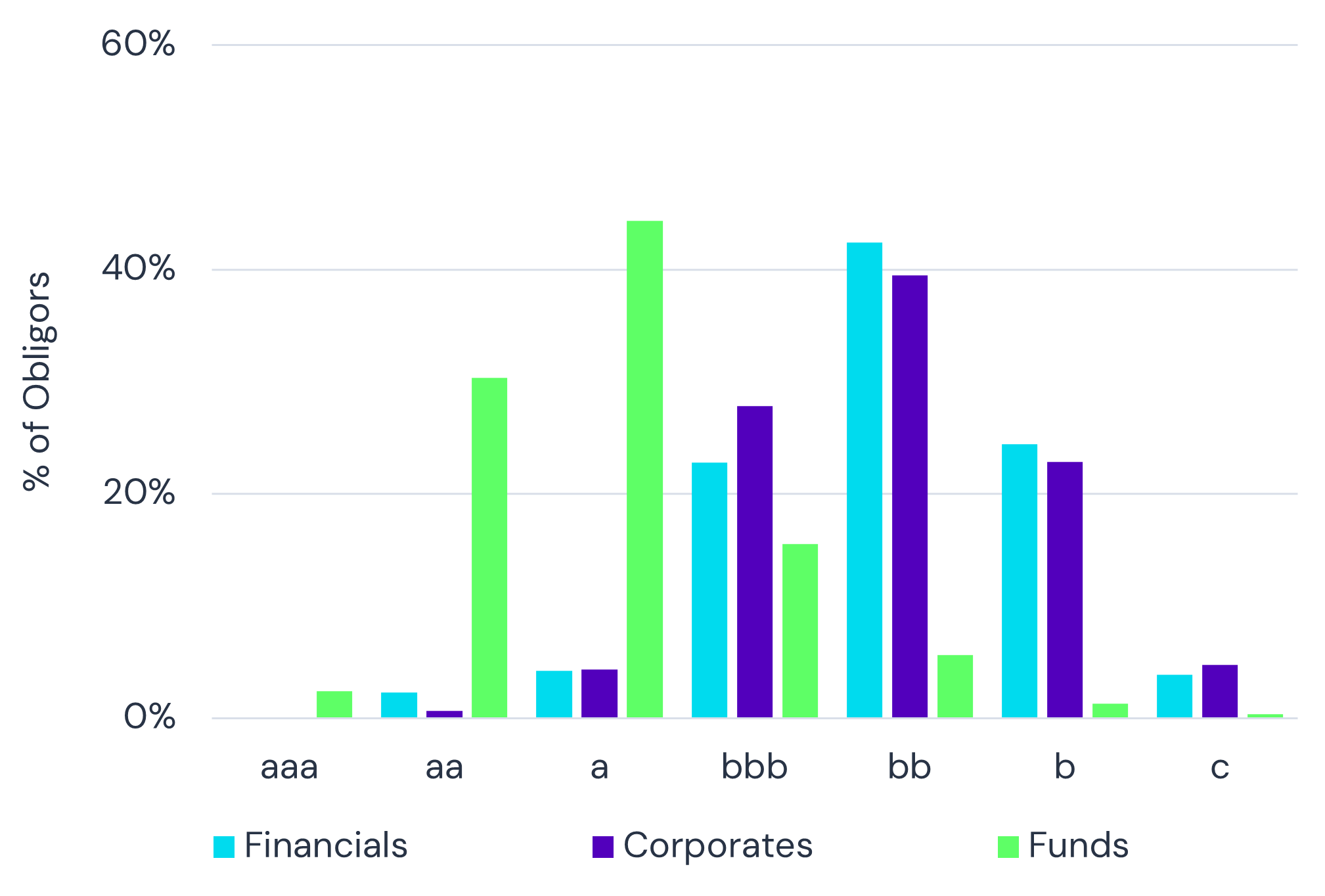
Italian Funds, Corporates and Financials sit at very different points on the credit-quality distribution, with one notable anomaly: Corporates and Financials look unusually alike.
- Funds are concentrated in a and aa, with only around 5% in ‘b’ or ‘c’.
- Corporates and Financials show unusually similar credit profiles, both clustered in ‘bb’.
- The convergence is uncommon versus European peers, where Financials typically sit at higher grades.
- Reflects the legacy of weaker mid-sized banks and a granular, SME-heavy corporate base.
Regional Default Risk in Italy: A North–South Divergence
Italy Consensus Risk Profile by Region

Default risk varies sharply across Italian regions, with a persistent North–South divide and pockets of concentrated tail risk that headline PDs alone do not capture.
- Highest average PDs: Calabria, Campania. Lowest: Veneto, Piemonte.
- Highest share of ‘c’ rated obligors: Calabria, Basilicata. Lowest: Veneto, Venezia.
- Highest share of ‘b’ rated obligors: Calabria. Lowest: Veneto.
- Elevated tail risk (‘c’% high vs ‘b’%): Trentino, Sardegna, Abruzzo, Lazio, Basilicata, Calabria.
Recent Rating Momentum: Financials Under Broader Downgrade Pressure
4-Month Balance of Deteriorations to Improvements: Italy Corporates
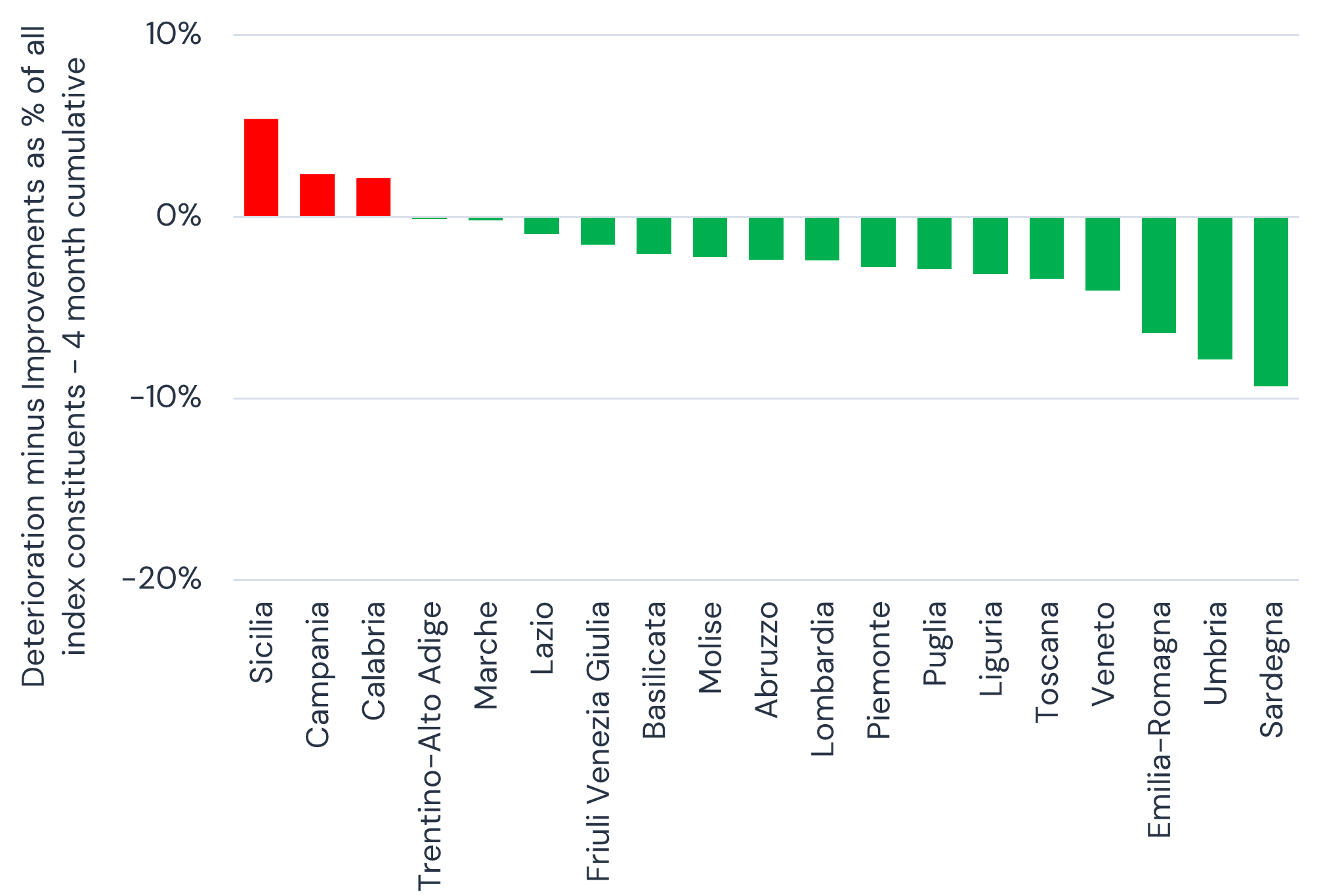
4-Month Balance of Deteriorations to Improvements: Italy Financials

Net upgrades and downgrades over the past four months reveal a clear divergence between Italian Corporates and Financials, with Financials under broader pressure but pockets of positive Corporate momentum visible across several regions.
- Financials post net downgrades in 10 regions vs only three for Corporates.
- Marche shows the largest Financial deterioration, with a ~20% net downgrade balance.
- Most other regional balances stay within +/- 5%, signalling broadly stable conditions.
- Sardegna, Umbria and Emilia-Romagna Corporates each post more than 5% net upgrades.
High Yield vs Investment Grade: Diverging Paths Across Corporates and Financials
Rebased Change in Credit Risk: Italy Corporates vs. Financials, Investment Grade vs. High Yield
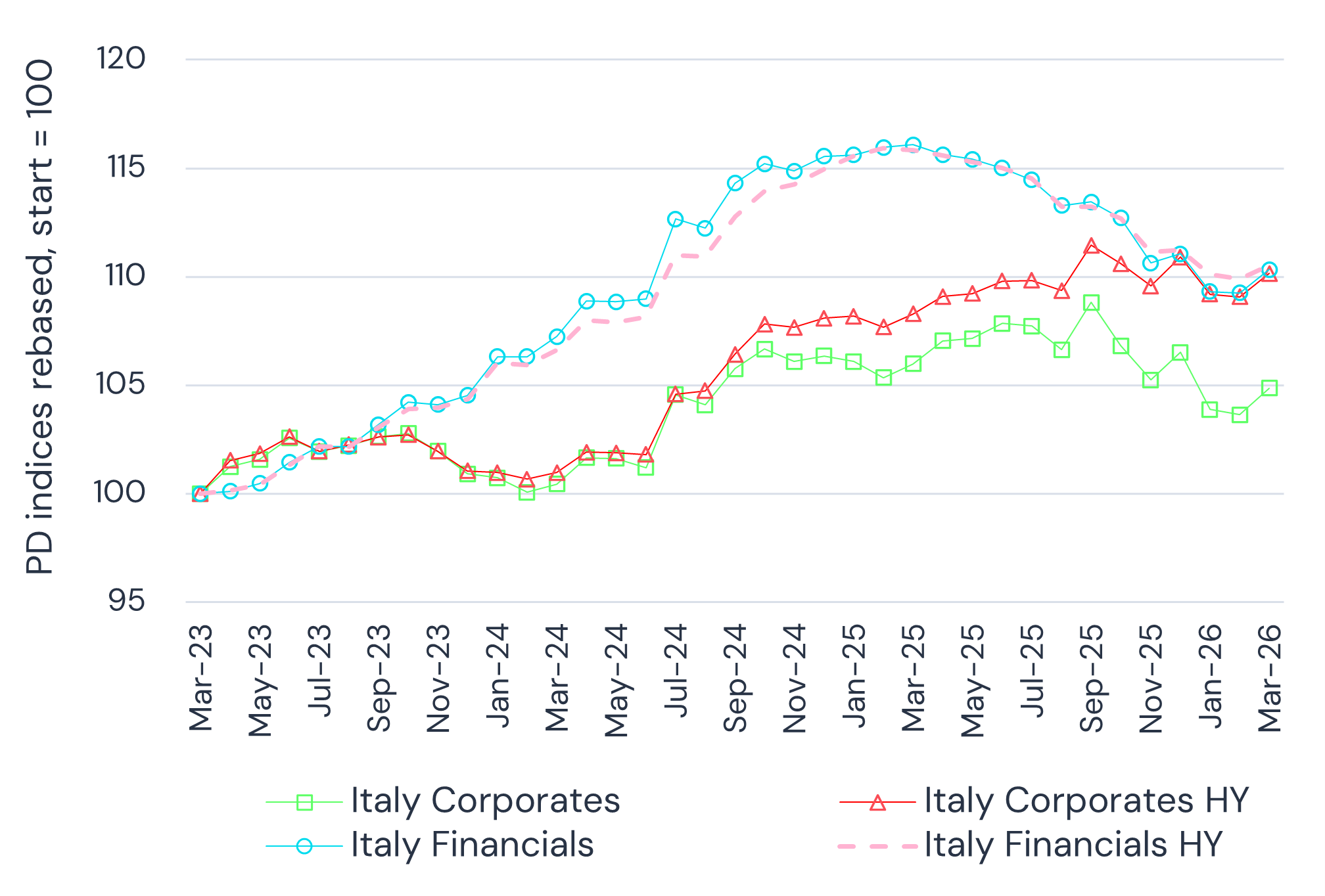
Three-year default risk trends split by rating bucket and issuer type point to a clear bifurcation, with weaker, lower-rated cohorts setting the direction in both Corporates and Financials.
- Italian Financials are mainly driven by High Yield Financial index movements.
- High Yield Corporates have recently diverged from the overall Italian Corporate trend.
- All four indices show slight deterioration in the past month, reflecting fresh geopolitical and energy pressures.
- Risk is increasingly concentrated in lower-rated, more cyclical issuers rather than spread evenly across the market.
Sector Credit Risk Index: Where Upgrades and Downgrades Are Concentrated
6-Month Credit Risk Index (CRI – Net Downgrades) Top 10 / Bottom 10, Investment Grade vs. High Yield
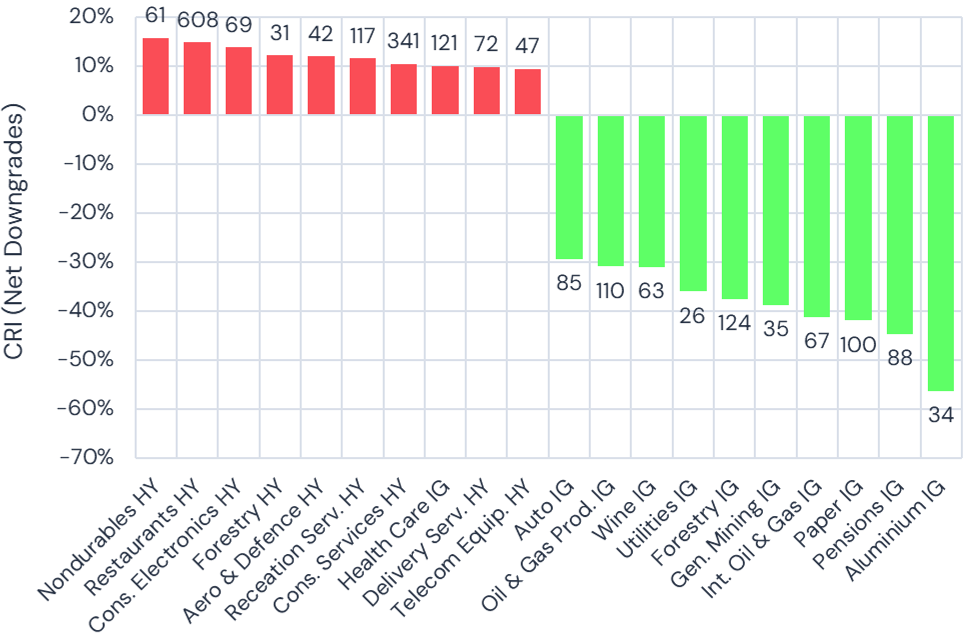
The Credit Risk Index (CRI) measures downgrades net of upgrades as a share of constituents. Ranking sectors by CRI shows a striking asymmetry: upgrades are far larger in scale than downgrades and skewed towards higher-quality cohorts.
- Largest upgrades are all Investment Grade: Metals & Mining, Oil & Gas, Forestry & Paper.
- Investment Grade Aluminium leads, with nearly 60% of constituents upgraded in six months.
- Downgrades are smaller in scale and mainly High Yield, with Health Care the main IG exception.
- The pattern reinforces a quality-led recovery, with weaker HY issuers absorbing most of the stress.
Italian Financial Sector Default Risk by Sub-Sector
Rebased Change in Credit Risk: Italy Financial Sub-Sectors
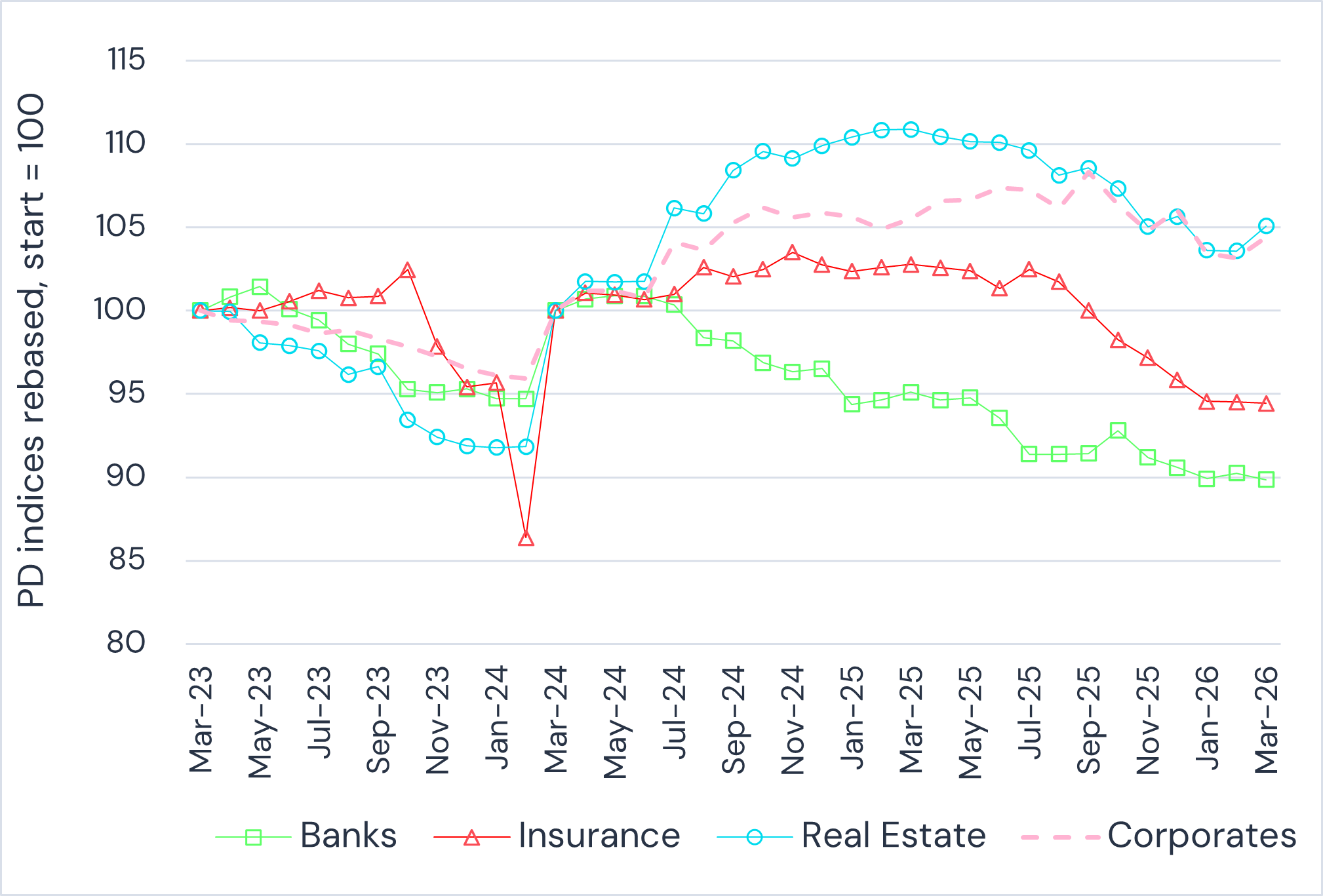
Indexed default risk across Italian financial sub-sectors over the past three years shows a broadly stable sector, with sub-sector trends diverging from the recent uptick in regional downgrade activity.
- Financials have been stable or improving over the past six to nine months.
- Real Estate risk is ticking up, in line with the broader Italian Corporate trend.
- Banks and Insurance are stabilising after steady improvement over the past year.
- Solid capital buffers continue to underpin the resilience of Italian banks.
Largest Six-Month Credit Deteriorations: Industrials Lead the Stress
6-Month PD Change by Sector / Geography (Red = HY, Green = IG)

Ranking the largest six-month PD deteriorations by geography, sector and rating helps locate where credit stress is most acute, with Industrial exposures dominating the picture.
- More than two-thirds of the largest deteriorations are High Yield.
- Major High Yield deteriorations are concentrated in Industrial sectors.
- Major Investment Grade deteriorations are also skewed to Industrial sectors.
- Deteriorations are widely spread geographically, with no single regional cluster dominating.
Regional Default Risk Trends: Correlation, Divergence and Recent Turning Points
Rebased Change in Credit Risk: Regional Comparison
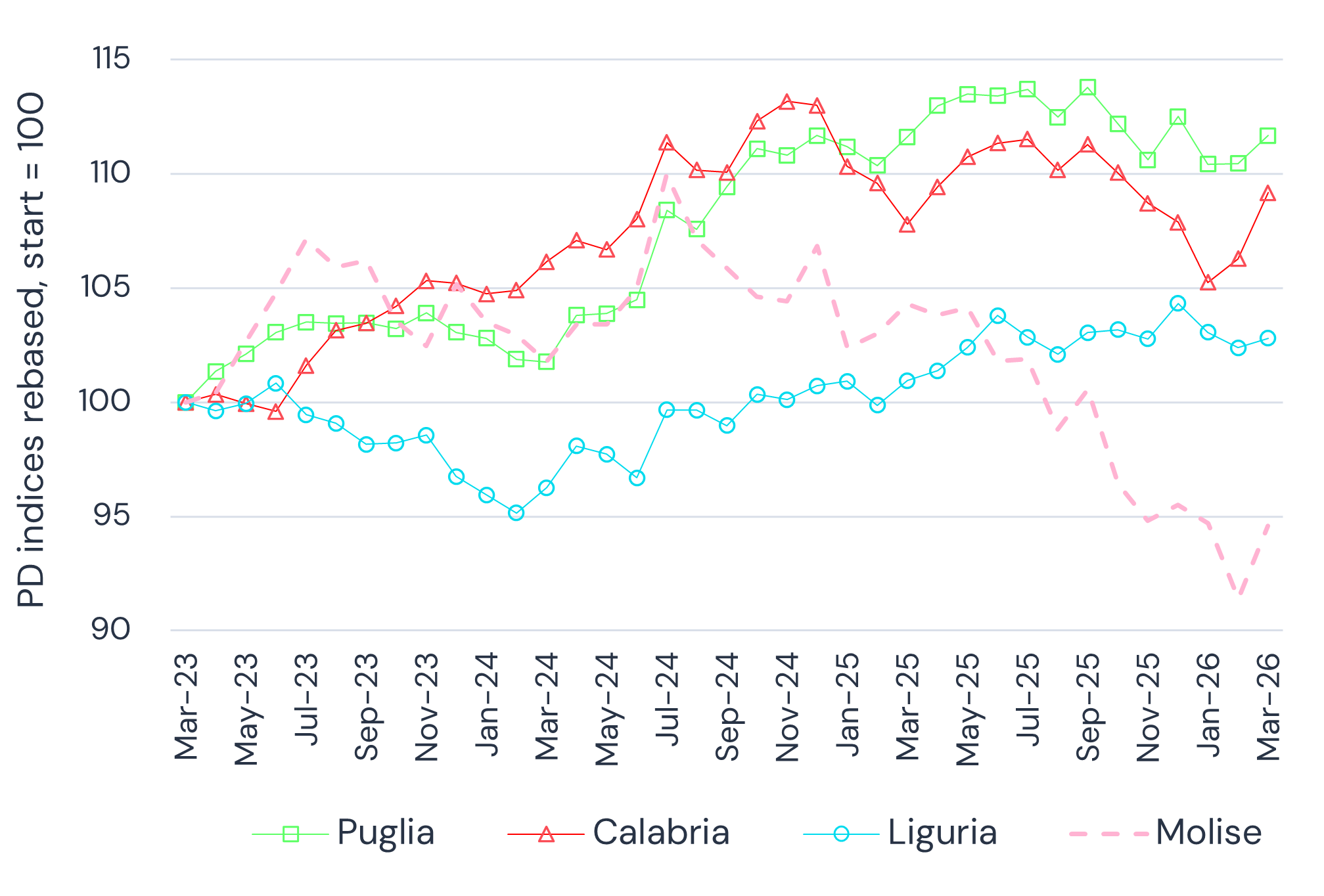

Indexed corporate default risk by region highlights both shared trends across Italy’s largest regions and meaningful divergence among smaller ones, with a common turning point emerging in early 2025.
- The four largest regions were highly correlated through 2023–24, with Lazio diverging since mid-2024.
- All four have improved in the past six months but show a turn towards deterioration in March.
- Smaller regions are less correlated; Puglia and Calabria show modest deterioration.
- Liguria has been more stable, while Molise has improved significantly.
Conclusion: Italian Credit Outlook for 2026
Italy’s credit environment entered 2026 from a position of relative resilience, supported by strengthening Investment Grade fundamentals, stable banking sector balance sheets and continued domestic economic support. However, recent data points to a more fragmented risk landscape, with geopolitical tensions, energy-market volatility and weaker macro momentum beginning to pressure more vulnerable segments of the market.
Credit stress remains concentrated in High Yield industrial borrowers and selected southern regions, while regional divergence and elevated tail-risk indicators highlight the growing importance of sector and geographic differentiation in credit assessment.
Although overall default risk remains within manageable levels, the recent broadening of downgrade activity – particularly across Financials – suggests credit conditions are becoming more uneven. Italy continues to demonstrate resilience relative to many global peers, but the outlook increasingly depends on the market’s ability to absorb external geopolitical and economic shocks without a wider deterioration in credit quality.
Appendix
Credit Benchmark Italian Consensus Coverage by Region
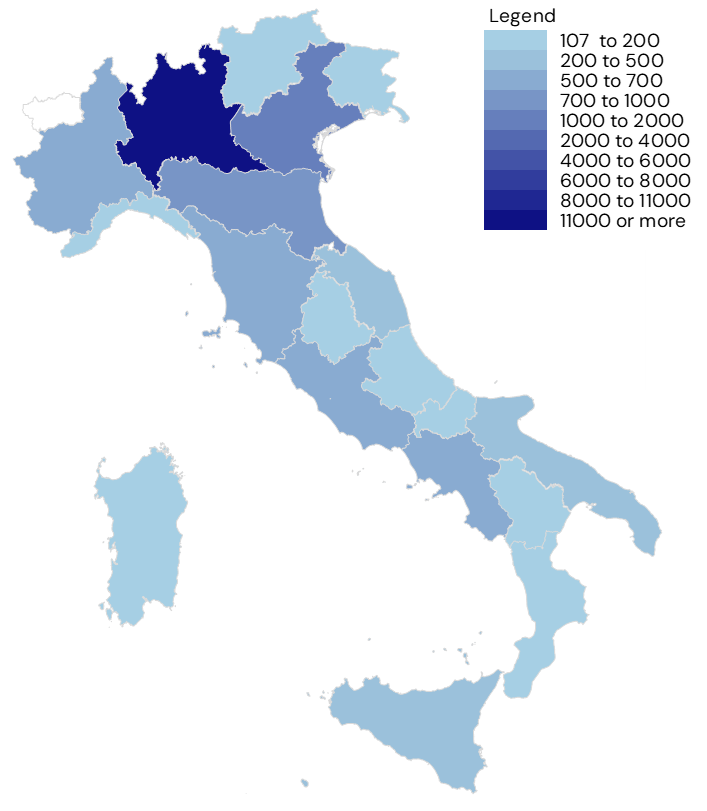
Credit Benchmark Italian Consensus Probability of Default (“PD”) by Region
Download PDF
Please complete your details to download the PDF of this report.
"*" indicates required fields
By submitting this form you agree to Credit Benchmark’s Privacy Policy and Terms and Conditions.




Want to see Credit Benchmark in action?
Schedule a short 30 minute demo and let our team walk you through the platform, demonstrate key capabilities, and answer any questions live.